
Career
Digital Marketing Course Fees in Kerala
Digital marketing course fees in Kerala generally range from ₹15,000 to ₹75,000, depending on duration, mode, certifications and the institute. This guide explains what...
Read more
Before joining a digital marketing institute in Kochi, evaluate its syllabus, trainer experience, practical sessions, course fees, batch size, internship quality, placement assistance and certification. In 2026-27, also check whether the course covers AI tools, SEO, AEO, GEO, analytics and marketing automation.
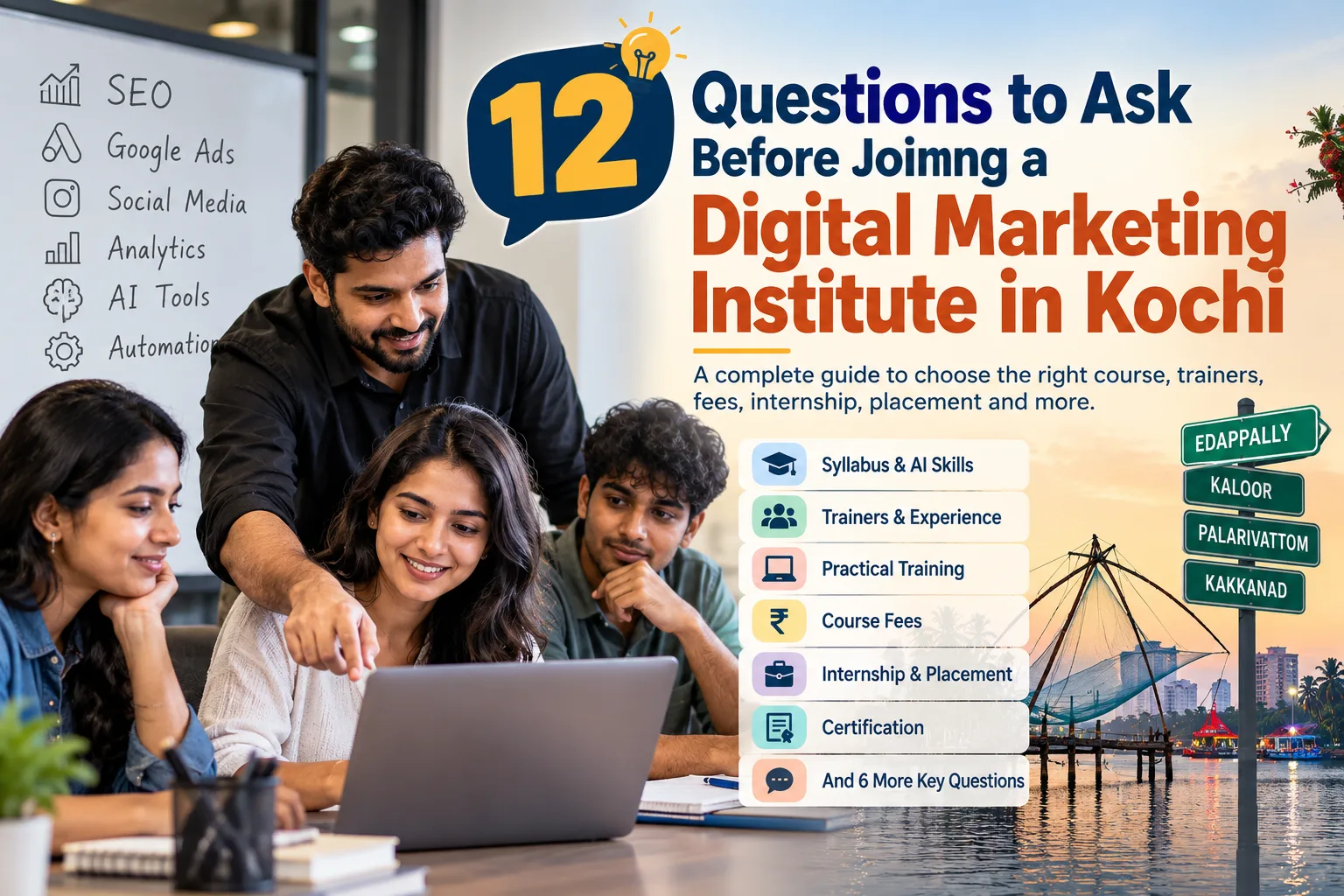
Quick answer: Before joining a digital marketing institute in Kochi, evaluate its syllabus, trainer experience, practical sessions, course fees, batch size, internship quality, placement assistance and certification. In 2026-27, also check whether the course covers AI tools, SEO, AEO, GEO, analytics and marketing automation. Request a detailed syllabus, inspect the learning environment and speak to former students before paying.
Kochi has several digital marketing training providers, including classroom institutes, online academies and programs offering practical internships. Students looking for a digital marketing course in Ernakulam can find options across Edappally, Kaloor, Palarivattom, Kakkanad and other parts of the city.
However, choosing the right institute is not as simple as searching Google for the "best digital marketing institute in Kochi" and selecting the first result.
Most institutes highlight attractive features such as industry-experienced trainers, practical sessions, placement assistance, certifications and live projects.
But what do these promises actually mean?
Does "practical training" mean watching a trainer demonstrate a tool, or will you perform the task yourself?
Does "internship included" mean working on meaningful projects, or simply receiving another certificate?
Does "AI-powered digital marketing" include real workflows and automation, or just using ChatGPT to generate social media captions?
These differences can significantly affect your learning experience.
Whether you are a Plus Two student, graduate, working professional, career changer, Gulf returnee or business owner, this guide will help you evaluate digital marketing institutes before making an admission decision.
At the end, we also explain how Brain Cyber Solutions approaches these same questions, allowing you to compare our training with other available options.
Use this checklist when comparing digital marketing courses in Kochi.
| # | Question | What you should expect |
|---|---|---|
| 1 | Is the syllabus updated for AI and modern digital marketing? | SEO, paid ads, analytics, AI search, AI tools and automation |
| 2 | Who will actually teach the course? | Named trainers with relevant practical experience |
| 3 | How much training is hands-on? | Practical exercises, project work and feedback |
| 4 | What is the total course fee? | Transparent fees, taxes and additional costs |
| 5 | What are the duration, timings and location? | Clear schedules and accessible facilities |
| 6 | How many students are in each batch? | Sufficient individual attention |
| 7 | Is there a genuine internship? | Defined projects, mentorship and portfolio output |
| 8 | What placement assistance is provided? | Verifiable career support without misleading promises |
| 9 | Who issues the certification? | Clear certification and assessment details |
| 10 | What language is used for teaching? | A language and teaching style you understand |
| 11 | Can you attend a demo or meet former students? | Opportunities to evaluate the training |
| 12 | What support continues after completion? | Clear post-course learning and career support |
Let's examine each question in detail.
Short answer: A digital marketing course in 2026-27 should cover fundamental marketing skills such as SEO, content, social media, Google Ads, Meta Ads and analytics. It should also introduce AI-assisted workflows, AI search visibility, conversion tracking and marketing automation. The syllabus must explain what students will actually build or practise, not merely list popular tools.
Digital marketing is much broader than managing social media accounts or improving Google rankings.
Businesses need professionals who can understand customer behaviour, attract relevant visitors, generate enquiries, measure results and improve conversions.
Consider a furniture showroom in Ernakulam.
To attract customers, the business might need:
A good digital marketing course should help students understand how these activities connect.
| Subject | Practical learning outcome |
|---|---|
| Website creation | Build or manage business websites and landing pages |
| SEO | Perform keyword research, website optimization and technical checks |
| Local SEO | Optimize a Google Business Profile and local business content |
| Content marketing | Develop content strategies, articles and campaign messaging |
| Social media marketing | Plan and evaluate social media activities |
| Google Ads | Understand campaign setup, targeting, budgets and measurement |
| Meta Ads | Plan Facebook and Instagram advertising campaigns |
| Analytics | Interpret GA4 reports and website performance |
| Conversion tracking | Understand events, tags and marketing attribution |
| AI-assisted marketing | Use AI tools responsibly across marketing activities |
| GEO and AEO | Understand search visibility in answer and generative AI experiences |
| Marketing automation | Connect forms, lead management tools and communication workflows |
Not every course needs to cover all these subjects at an advanced level. A short introductory course may prioritize foundational knowledge, while a specialized course may focus on SEO, performance marketing or automation.
What matters is that the syllabus matches your intended career and provides realistic learning outcomes.
Modern digital marketing students should understand these overlapping areas.
| Discipline | Meaning | Example |
|---|---|---|
| SEO | Search Engine Optimization | Improving a service page's organic visibility in Google |
| AEO | Answer Engine Optimization | Providing clear, useful answers to questions people ask through search and AI interfaces |
| GEO | Generative Engine Optimization | Improving the discoverability, clarity and representation of a brand in generative AI search experiences |
For example, a business might want its website to rank for "interior designers in Kochi" while also making its services understandable to AI-powered search systems.
Traditional SEO remains fundamental to this process. AEO and GEO introduce additional considerations around content clarity, entities, sourcing and AI-generated answers.
No institute can legitimately guarantee that a business will always be recommended by ChatGPT, Gemini, Perplexity or Google AI search features.
AI has applications across many digital marketing activities.
Students may use ChatGPT or Claude for research and drafting, Gemini for certain multimodal workflows, NotebookLM for source-based research, and n8n for workflow automation.
However, the goal should not be simply learning a list of AI tools.
Students should develop the ability to verify generated information, apply marketing judgment, protect customer data and understand when automation is appropriate.
Ask the institute: "Can you share the complete syllabus and show the practical assignments that cover AI, SEO, advertising, analytics and automation?"
Watch out for: A course promoted as AI-powered when the only AI lesson is an introductory prompt-writing session.
Short answer: Look for trainers who have relevant experience working on websites, advertising campaigns, analytics, automation or other digital marketing projects. Ask for the names of your actual instructors, their areas of expertise and examples of recent professional work. Training ability matters alongside industry experience.
Digital marketing involves practical decisions that cannot always be learned from textbooks.
For example, imagine a Google Ads campaign receives 500 clicks but generates only three enquiries.
An experienced performance marketing professional should be able to investigate possible problems involving keyword intent, audience targeting, landing pages, conversion tracking and lead quality.
Similarly, an SEO professional should understand why a website may not gain visibility even after content and technical improvements.
These scenarios require analysis rather than memorizing definitions.
Ask for:
An institute may have separate specialists for SEO, performance marketing, social media, analytics and automation.
That can be beneficial because one person does not need to be an expert in every marketing discipline.
A professional who manages large advertising budgets may be technically strong but unable to explain concepts clearly to beginners.
Similarly, a confident classroom trainer may lack recent campaign experience.
Ideally, look for both.
Ask the institute: "Who will teach my batch, what subjects do they specialize in, and can I see examples of their recent work?"
Watch out for: Vague claims about industry experts without identifying the actual trainers.
Short answer: Practical digital marketing training should require students to perform real tasks, complete assignments and receive feedback. Useful exercises include building websites, auditing SEO, planning advertising campaigns, configuring analytics and creating marketing reports. Watching demonstrations alone is not enough to develop practical confidence.
There is a difference between knowing what Google Search Console does and using it to investigate an indexing issue.
The same applies to creating advertising campaigns, configuring Google Analytics events or developing marketing automation workflows.
Students need opportunities to make decisions, identify mistakes and understand how to correct them.
A beginner-friendly digital marketing program might include these projects.
Project 1: Website creation
Create a business website or landing page using WordPress or another suitable platform.
Project 2: SEO audit
Analyze a website's technical health, content relevance, internal links and search performance.
Project 3: Content marketing strategy
Prepare a keyword map, editorial plan and content briefs for a business.
Project 4: Advertising campaign
Plan a Google Ads or Meta Ads campaign with targeting, budgets, creative ideas and conversion goals.
Project 5: Analytics reporting
Configure or review website events and prepare a performance report using GA4 or Looker Studio.
Project 6: Marketing automation
Create a simple workflow connecting a lead form to a spreadsheet or CRM, with a follow-up notification.
Paid advertising campaigns may be conducted through simulations or supervised environments when live advertising budgets are unavailable.
The important factor is meaningful participation, not the amount spent on advertising.
By completing projects, students can develop a portfolio containing website audits, campaign plans, sample landing pages, reporting dashboards and workflow demonstrations.
Such work can be useful in interviews and freelance discussions.
Ask the institute: "What projects will I personally complete, and will trainers review my work?"
Watch out for: Practical training that consists entirely of watching the instructor operate the software.
Short answer: Compare the complete course fee, including applicable taxes, certification, practical resources and other compulsory expenses. Digital marketing course fees vary depending on duration, syllabus, teaching format and support. The cheapest course is not necessarily the best value, and higher fees do not automatically mean better training.
Ask whether the advertised fee includes:
Also check payment schedules, refund policies and any financing fees.
Suppose the advertised course fee is ₹25,000 plus 18% GST.
| Component | Amount |
|---|---|
| Course fee | ₹25,000 |
| GST at 18% | ₹4,500 |
| Total payable | ₹29,500 |
This calculation assumes 18% GST applies to the course.
When comparing courses, you can also calculate the cost per instructor-led training hour. However, this should be considered alongside internship quality, practical support and course outcomes.
A course with fewer but more effective supervised hours may deliver better value than a longer course with limited interaction.
For further details, read our Digital Marketing Course Fees in Kerala guide.
Ask the institute: "What is the final payable amount, including taxes, certification, software, practical projects and any other compulsory charges?"
Watch out for: Unclear additional fees or pressure to make an immediate payment without understanding the terms.
Short answer: Choose a course with a realistic timetable, sufficient practical hours and a convenient learning location. For offline digital marketing training in Kochi, consider daily commuting time, public transport, class schedules and opportunities to practise between sessions. Duration matters less than structured learning and demonstrable outcomes.
Not necessarily.
A course lasting six months may provide more time for learning, but the value depends on how that time is used.
A shorter program with regular supervised assignments can be useful for learning fundamentals. However, students should not expect advanced mastery of every digital marketing discipline within a few weeks.
| Factor | Offline classroom training | Live online training |
|---|---|---|
| Interaction | Face-to-face | Video and online discussions |
| Practical support | In-person assistance | Remote screen sharing |
| Travel | Requires commuting | No daily commute |
| Schedule | Usually fixed | Varies by program |
| Peer interaction | Direct classroom contact | Digital communities |
| Flexibility | Often lower | Often higher |
Students living around Edappally, Palarivattom, Kaloor, Aluva or other parts of Ernakulam should consider their regular commute.
A training centre close to a metro station or major transport route can make daily attendance more convenient.
Some programs combine offline classroom learning with a later online internship or project phase.
This structure can help students receive direct guidance initially and then practise through more independent work. For a fuller comparison, read online vs offline digital marketing courses in Kerala.
Ask the institute: "How many supervised learning hours are included, what are the exact timings, and where is the training centre?"
Watch out for: Unclear schedules, unexpected timetable changes or a venue that has not been confirmed.
Short answer: Batch size affects how easily trainers can provide individual guidance during practical sessions. Smaller groups may help students receive faster feedback, but the quality of supervision also depends on the number of trainers, teaching assistants, facilities and course structure.
Imagine 40 students trying to configure Google Tag Manager during a single practical class.
Some may complete the work quickly, while others encounter technical problems.
Without sufficient trainer support, students can fall behind.
A well-managed classroom should offer opportunities to ask questions, troubleshoot issues and receive feedback.
Inspect the following:
There is no universally correct batch size, but students should understand how the institute will support everyone enrolled.
Ask the institute: "What is the maximum number of students per batch, and how do trainers provide individual support?"
Watch out for: No clear batch limit or insufficient facilities for practical laptop-based learning.
Short answer: A valuable digital marketing internship should provide structured assignments, practical work, supervision and regular feedback. Students should know whether they will work on client projects, internal business projects or simulations, and what deliverables they can include in their portfolio.
During classroom training, students learn concepts and practise individual tasks.
An internship can help them understand how those tasks fit into larger business requirements.
For example, a student may be assigned to improve a local business website.
The work could involve:
This provides experience in problem-solving and reporting.
Look for clearly defined responsibilities, mentor reviews, deadlines and feedback.
Ask whether the work is supervised and whether students can demonstrate their contributions afterward.
Respect for client confidentiality is also important. Students should not publish private customer data, campaign accounts or internal reports without permission.
An internship certificate may document participation, but it does not automatically establish what skills a student developed.
A genuine project portfolio can provide additional evidence.
Ask the institute: "What exact projects will I work on during the internship, who will supervise them, and what portfolio materials can I retain?"
Watch out for: Internships that consist only of attendance or certificates without meaningful assignments.
Short answer: Placement assistance generally refers to support such as resume preparation, interview guidance, portfolio reviews and information about job opportunities. It does not automatically guarantee employment. Students should ask for the institute's written policy and evidence of recent placement outcomes.
Services can include:
The availability of these services differs between institutes.
| Entry-level role | Main responsibilities |
|---|---|
| SEO Executive | Keyword research, content optimization and technical SEO |
| Digital Marketing Executive | Supporting multiple marketing channels |
| Social Media Executive | Social content, engagement and reporting |
| PPC Trainee | Assisting with paid advertising campaigns |
| Content Marketing Executive | Creating and optimizing marketing content |
| Marketing Analytics Trainee | Tracking, reporting and data interpretation |
| Marketing Automation Trainee | Lead management and workflow support |
Employers may assess both theoretical understanding and practical ability. For typical pay at these levels, see our guide to digital marketing salary in Kerala.
A portfolio can help demonstrate experience, but employment also depends on vacancies, interview performance, communication and other role-specific requirements.
Ask whether the institute can share recent, independently verifiable outcomes.
If it advertises guaranteed placement, request written details of the conditions and what happens if a job is not secured.
Avoid relying only on company logos or promotional statements.
Ask the institute: "What specific placement support will I receive, and can you show recent verifiable student outcomes?"
Watch out for: Employment guarantees without clear written terms.
Short answer: Before enrolling, confirm the exact name of the certificate, the issuing organisation and the requirements for earning it. An institute-issued certificate, proprietary professional certification and third-party platform credential are different qualifications. Practical skills and portfolio evidence remain important alongside certification.
Students may encounter several types of credentials.
Institute certificates: Issued by a training provider after completion or assessment.
Professional training certifications: Issued by training organisations under a defined certification program.
Platform credentials: Offered by platforms or education providers, such as Google Skillshop or HubSpot Academy, under their applicable learning and assessment rules.
Each may have different requirements and recognition.
Find out whether students must complete assignments, pass assessments or meet attendance requirements.
Also confirm whether the certificate can be independently verified.
A certificate should not be described as government-approved, university-accredited or equivalent to a formal academic qualification without appropriate evidence.
Ask the institute: "Who issues the certification, what assessment is required, and how can an employer verify it?"
Watch out for: Unverifiable claims about official recognition or accreditation.
Short answer: The best teaching language is one in which you can clearly understand technical concepts and participate in practical sessions. Malayalam explanations may help some Kerala students learn comfortably, while English terminology remains useful because many marketing platforms and professional resources use English.
Digital marketing introduces many technical terms, including:
A trainer who explains these concepts clearly can help beginners build confidence.
For some students, bilingual instruction may make learning easier.
However, understanding technical English terminology is still useful for working with marketing tools, documentation and client reports.
Ask which language is used during classroom explanations, assignments and assessments.
Also check whether learning materials are provided in Malayalam, English or both.
Ask the institute: "Are the classes taught in Malayalam, English or both, and can I attend an introductory session to understand the teaching style?"
Watch out for: Significant differences between the language promised during admission and the language actually used in classes.
Short answer: A demo class or classroom visit can help evaluate the teaching style, practical facilities and learning environment. Former students may provide useful information about course delivery, projects and ongoing support. Reviews and testimonials are helpful, but should not replace independent evaluation.
Pay attention to whether the trainer explains concepts clearly, encourages questions and demonstrates practical applications.
Observe the classroom setup and opportunities for interaction.
If a demo class is unavailable, ask whether an introductory session, facility visit or syllabus discussion is possible.
Look beyond overall star ratings.
Detailed reviews describing assignments, trainer guidance and actual skills learned are generally more informative than generic praise.
Consider the review dates and whether the experiences described relate to the current course.
Reviews from older courses may provide useful background about an institute, but they do not necessarily establish the quality of a newly introduced program.
Where possible, speak to former students who consent to being contacted.
Ask the institute: "Can I visit the classroom, experience the teaching approach and review genuine student projects or feedback?"
Watch out for: Pressure to enrol immediately without sufficient information about the course.
Short answer: Post-course support can help students continue learning as digital marketing tools and practices change. Depending on the institute, support may include alumni communities, doubt-clearing sessions, educational workshops, career updates or mentoring. Confirm what is included, how long it lasts and whether additional fees apply.
Digital marketing tools and platforms evolve regularly.
A student who completes training may later encounter new problems while managing a website, advertising campaign or automation workflow.
Access to a learning community can be useful for asking questions, exchanging experiences and learning about changes.
An active professional community can be valuable, but students should distinguish between free support and separately priced advanced training.
Ask the institute: "What support continues after course completion, for how long, and which services require additional payment?"
Watch out for: Vague promises of lifetime support without defining what that actually includes.
Not every warning sign proves an institute is unsuitable. However, several unresolved concerns should prompt closer examination before paying.
A credible institute should be willing to answer reasonable questions and explain its policies clearly.
Once you have shortlisted two or three institutes, use a consistent evaluation method.
Give each institute a score out of 10 for every category.
| Evaluation criteria | Suggested weight |
|---|---|
| Syllabus relevance, including AI and search | 20% |
| Practical projects, internship and portfolio | 20% |
| Trainer experience and teaching quality | 15% |
| Career support and verifiable outcomes | 15% |
| Course fee and overall value | 10% |
| Batch size and individual attention | 10% |
| Location, timings and teaching language | 10% |
| Total | 100% |
Calculate a weighted score by multiplying each category score out of 10 by its assigned weight and adding the results.
For example, a syllabus score of 8 out of 10 contributes 16 points out of the possible 20 points for that category.
These weights are only a suggested decision framework.
A business owner may prioritize marketing automation and business applications instead of placement assistance.
A student seeking an entry-level job may prioritize internships, projects and career support.
The right digital marketing institute is the one that meets your particular learning needs, not simply the one with the highest advertising visibility.
Different students need different types of training.
Look for beginner-friendly teaching, practical sessions and portfolio development.
A computer science degree is not normally required to begin studying digital marketing. See also our guide to the digital marketing course for freshers.
Technical backgrounds can be useful for website development, technical SEO, analytics and automation.
However, students should also learn communication, content strategy and customer behaviour.
Choose a program that fits your work schedule.
Consider learning skills that complement your existing experience, such as performance marketing, analytics, SEO or automation.
Focus on transferable skills, recent practical projects and realistic career expectations.
A structured internship may help demonstrate newly acquired skills, but career transitions depend on more than course completion.
Prioritize lead generation, Google Business Profile, advertising, conversion tracking, customer communication and marketing automation. Our AI Business Automation Course (MCAIS) focuses on these systems.
Develop strong skills in a specific service before attempting to offer every digital marketing solution.
Client management, communication and reporting are equally important.
At Brain Cyber Solutions, we believe students should be able to evaluate our course using the same criteria we recommend for other institutes.
We offer the Certified AI Digital Marketing & Automation Course in Ernakulam, delivered under our Maattam training initiative.
Brain Cyber Solutions has worked in SEO and digital marketing since 2005. Our training combines digital marketing fundamentals with practical applications of AI, search optimization, advertising, analytics and automation.
Here are our published course details.
| Question | Brain Cyber Solutions course details |
|---|---|
| 1. Is the syllabus updated? | Includes WordPress, Shopify, technical SEO, entity SEO, GEO, Google Business Profile, Google Ads, Meta Ads, GA4, Looker Studio, n8n, WhatsApp API, CRM and AI tools |
| 2. Who teaches? | Practising professionals including Neeraj R Chandran, Abhijith MJ, Vishnu Velluva, Sonu Sabu John, Rajagopal P R and founder Syam K S |
| 3. Is the training practical? | Practical exercises using marketing, analytics, website and automation tools |
| 4. What is the fee? | ₹25,000 + GST, totaling ₹29,500 at 18% GST. EMI, instalments, UPI and card payments are available |
| 5. What is the duration? | Two months: one month offline classroom training and one month online internship |
| 6. What is the batch size? | Maximum 20 students per batch |
| 7. Is there an internship? | One-month online internship on real projects, with mentor feedback and portfolio development |
| 8. Is placement support available? | Placement assistance and ongoing support, without a guaranteed job promise |
| 9. What certification is awarded? | MCAIM, Maattam Certified AI Marketer, issued under the Maattam training initiative |
| 10. What is the teaching language? | Contact the training team to confirm the language of instruction for the upcoming batch |
| 11. Can students evaluate the training? | Student reviews are published, and prospective learners can enquire about a classroom visit or introductory session |
| 12. What support continues? | WhatsApp support group, Maattam community learning activities and placement assistance |
Meet the trainers on our experts page, or read our published student reviews.
Classroom training is scheduled on weekdays for four hours per day.
The published slots are:
Training centre: 7th Floor, National Pearl Star, High School Junction / Devankulangara, Edappally, Kochi, Kerala 682024.
The centre is near Changampuzha Park Metro Station. See the map and directions.
A new batch is scheduled every month. Contact the training team to confirm the next starting date and available seats.
The course covers website creation, SEO, entity and semantic SEO, GEO, Google Business Profile, paid advertising, conversion tracking and marketing automation.
Students are also introduced to tools including ChatGPT, Claude, Gemini, Perplexity, NotebookLM, WordPress, Shopify, Google Analytics, Google Search Console, Google Tag Manager, Looker Studio and n8n.
The second month focuses on practical project work through an online internship.
The program is intended for fresh graduates, career changers, working professionals, business owners and other learners interested in developing practical digital marketing skills.
No previous programming experience is required. Basic computer skills and access to a laptop are expected.
Because the current classroom timetable is on weekdays, learners who can attend only on weekends should check for alternative training formats.
MCAIM stands for Maattam Certified AI Marketer.
It is the training program's own certification, offered through the Maattam initiative under Brain Cyber Solutions.
It should not be confused with a government-issued academic qualification or a third-party platform certification.
If you are considering an offline digital marketing course in Kochi, compare our syllabus, trainers, projects and facilities with other available programs.
View the Certified AI Digital Marketing & Automation Course
You can also call +91 73068 95402 to ask about the syllabus, class timings, fee, internship and upcoming batches.
The best digital marketing institute in Kochi depends on your goals, budget and preferred learning format. Compare institutes based on their syllabus, trainer expertise, practical projects, internships, placement support and genuine student outcomes. Ideally, evaluate several institutes using the same checklist before enrolling.
Digital marketing course fees in Kochi vary depending on duration, specialization, teaching format and included services. Request the full fee, including applicable taxes and additional costs. Brain Cyber Solutions currently lists its two-month AI Digital Marketing & Automation Course at ₹25,000 plus GST.
Beginners can develop foundational knowledge within a few months of structured training and practice. Becoming proficient in managing live campaigns, analyzing performance and making strategic decisions generally takes additional experience. Course duration alone does not determine job readiness.
Yes. Many beginner-level digital marketing courses accept students after Plus Two. Students from arts, commerce, science and technical backgrounds can learn digital marketing, although individual institute eligibility requirements may differ.
Offline training may suit students who prefer classroom interaction, fixed schedules and face-to-face practical support. Online courses offer flexibility and remote access. Both can be effective when they provide good instruction, assignments and feedback.
Placement assistance does not automatically guarantee employment. Institutes may provide interview preparation, portfolio reviews and job referrals, but final hiring decisions depend on employers and individual candidates. Always review any guarantee carefully.
Digital marketing remains relevant as AI changes how research, content, analytics and marketing operations are performed. Professionals still need strategy, communication, creativity, commercial judgment and measurement skills. Students should learn AI alongside core marketing principles.
Coding is not required for many entry-level digital marketing activities. However, basic HTML, website fundamentals and an understanding of scripts can help with technical SEO, conversion tracking and automation.
GEO is useful for understanding how brands and information are represented in generative AI search experiences. It should be learned alongside traditional SEO, content quality, entity understanding and analytics. No GEO technique guarantees inclusion in AI-generated answers.
A focused two-month course with meaningful practical work can help a beginner build foundational skills and a portfolio. However, job readiness depends on the learner, training quality, employer requirements and continued practice. Advanced proficiency normally develops through experience.
Some training providers in Kerala offer Malayalam or bilingual instruction. Ask the institute about the actual teaching language, learning materials and practical sessions before enrolling. Knowledge of English technical terms remains helpful because many marketing platforms use English interfaces.
A course project is a structured assignment completed during training. An internship usually involves a period of supervised practical work with defined responsibilities, deliverables and feedback. The quality of the learning experience matters more than the label.
A course covering AI and automation may be useful if you want to work with modern marketing workflows, CRM systems, reporting and customer communication. However, AI tools should support, rather than replace, fundamental knowledge of marketing strategy, customer behaviour and measurement.
Check its business identity, actual training location, trainer profiles, published course information, independent student feedback and clear payment terms. Request verifiable evidence for placement, accreditation and certification claims before paying.
Choosing a digital marketing institute in Kochi is an investment in your future skills and opportunities.
The right decision should be based on more than course advertisements, attractive certificates or promises of employment.
Ask about the curriculum, meet the trainers where possible, review practical projects, understand internship arrangements and compare the total cost.
Look for a learning environment where you can practise, ask questions, receive feedback and develop demonstrable skills.
Most importantly, choose a course that matches your career goals and prepares you to keep learning as digital marketing evolves.
Considering classroom digital marketing training in Ernakulam?
Explore the Certified AI Digital Marketing & Automation Course at Brain Cyber Solutions or contact our training team to discuss the next batch.
Career
Digital marketing course fees in Kerala generally range from ₹15,000 to ₹75,000, depending on duration, mode, certifications and the institute. This guide explains what...

Career
Online courses win on flexibility and travel; offline courses win on focus, daily practice and direct feedback. This guide compares the two for learners in Kerala, and...
Career
The best AI course in Kerala depends on your goal and your qualification. After 12th or with any degree even an unfinished one, start with a short applied AI course...