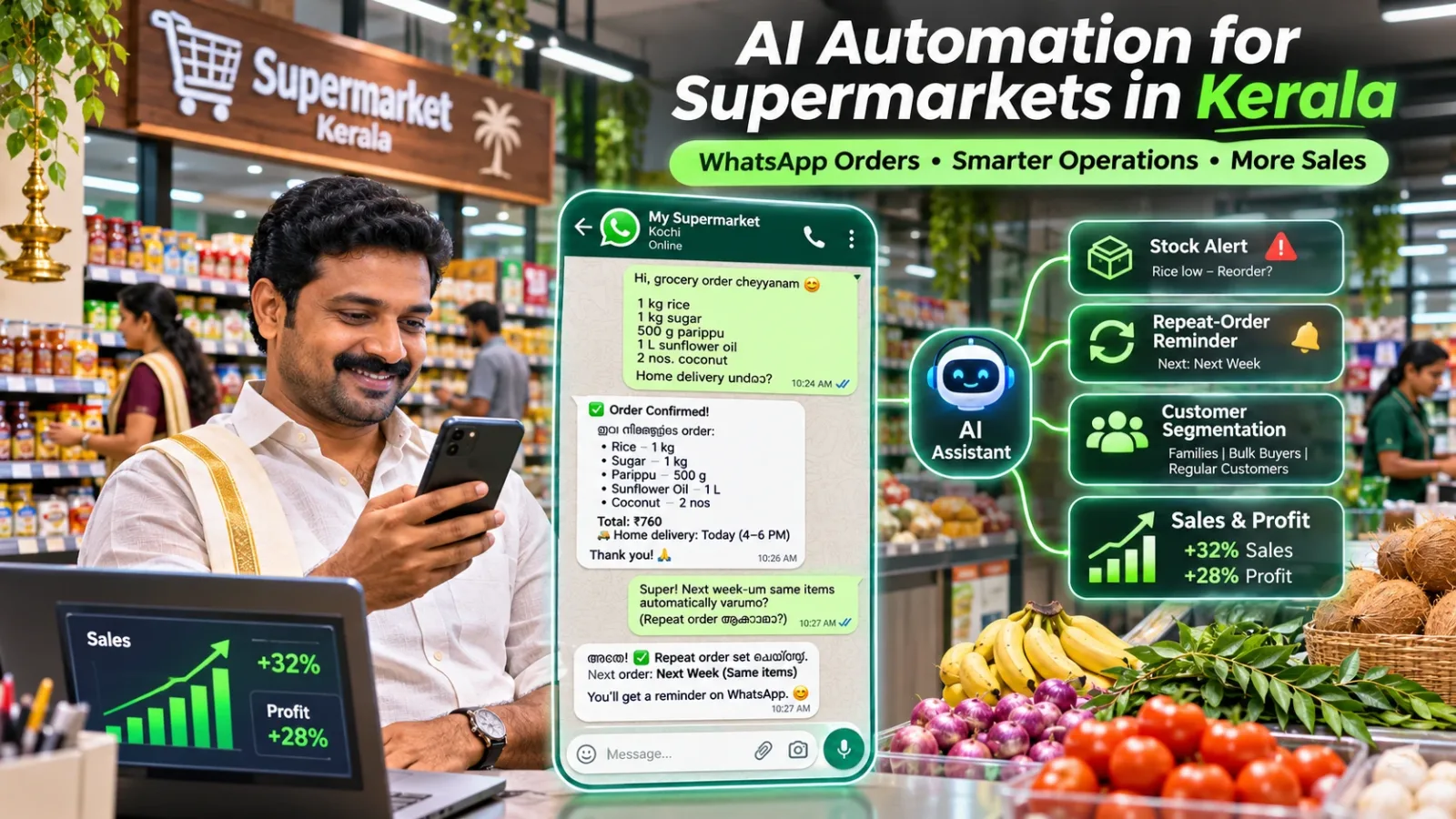
Picture a supermarket in Edappally at 7 pm. The billing counters are full, staff are restocking shelves, and the shop's WhatsApp keeps buzzing:
"Chetta, 5 kg matta rice undo?" "Can you deliver to Kakkanad today?" "നാളെ രാവിലെ പാൽ, ബ്രെഡ്, മുട്ട കിട്ടുമോ?"
Some messages get answered at once. Others wait an hour, or are never answered. Meanwhile, quick commerce riders are delivering to the same apartment blocks.
Now imagine the shop's WhatsApp could understand each message, check stock, prepare the order, update the customer and alert the packing team. The same system could remind regular customers about their monthly purchases, flag curd and bread nearing expiry, and warn the owner before coconut oil runs out. That is what AI and WhatsApp automation make possible.
Quick answer: AI automation for supermarkets in Kerala connects WhatsApp, artificial intelligence, billing software and automated workflows so a store can capture more orders, bring customers back more often, cut repetitive staff work and reduce inventory losses. A supermarket does not need its own mobile app or a new billing system to start.
When I design one of these systems, I check the same four parts I described in our guide to AI automation for Kerala and UAE businesses: a trigger (a customer message arrives, stock drops below a level, the shop closes for the day), the steps that follow, a failure path for when something breaks, and a named owner at the store. A supermarket is no different. You will see those four parts in every use case below.
This guide covers verified Kerala retail statistics, ten practical use cases, an honest profit calculation, costs, legal requirements and a 30-day starting plan, for supermarkets in Kochi, Thrissur, Kozhikode, Malappuram, Kottayam, Thiruvananthapuram and smaller towns across Kerala.
Why is Kerala a strong market for supermarket automation?
Quick answer: Kerala has thousands of supermarkets but few offered online ordering in the last state survey, household spending is well above the national average even in villages, most emigrant families are Gulf-connected, and quick commerce has already reached Kochi. That mix makes WhatsApp-first ordering and retention a practical opportunity, though results depend on each store's economics.
Kerala has thousands of supermarkets, and few sell online
The Kerala Department of Economics and Statistics' Survey on Markets in Kerala 2021-22 (published March 2025) counted 5,774 modern retail shopping establishments:
Source: Kerala DES, Survey on Markets in Kerala 2021-22. These are 2021-22 figures, not today's store count, and the survey measured online shopping, not WhatsApp or AI use. Still, two points stand out: most stores are owner-run and two-thirds sit in panchayat areas, and fewer than 6 in 100 offered any online ordering. For those stores, WhatsApp ordering is the lowest-cost way to go digital.
Kerala households spend more, in villages too
Kerala's urban-rural gap is about 18%, the lowest of the major states, against 70% nationally. Sources: MoSPI HCES 2023-24, Kerala Kaumudi. These cover all goods and services, not groceries alone. Kerala households also spend the largest share of their food budget on egg, fish and meat in India (rural 23.5%, urban 19.8% in HCES 2022-23), the categories that spoil fastest (Drishti IAS).
So digital ordering is not just a Kochi or Thiruvananthapuram idea. Supermarkets in Perinthalmanna, Muvattupuzha, Kottarakkara, Changanassery and Thalassery serve shoppers with near-city budgets.
Gulf-connected families are a customer segment
Kerala received 19.7% of India's inward remittances in 2023-24, second only to Maharashtra (Onmanorama, citing RBI). The Kerala Migration Survey 2023 found that 80.5% of Kerala's emigrants live in Gulf countries (The Wire). Many of them already pay for their parents' household needs.
Quick commerce has arrived
Blinkit went live in Kochi on 3 September 2024, just before Onam, with its first store in Kaloor serving Kaloor Stadium, Palarivattom and Jawahar Nagar (Outlook Business). Nationally, a Google and Redseer report released in October 2026 puts quick commerce at about US$13 billion in FY26 and projects US$90 billion by FY31 (IBEF). The same report notes that outside the metros, smaller baskets, freshness concerns and trust still hold quick commerce back.
Those are exactly the areas where a familiar neighbourhood supermarket is strongest. Automation helps it keep that edge while making ordering as easy as an app. For the wider picture of online retail in the state, see our post on Kerala ecommerce marketing trends.
What is AI automation for supermarkets?
Quick answer: AI automation for supermarkets is the use of artificial intelligence, business software and automated workflows to handle grocery orders, customer questions, stock alerts, purchase reminders, loyalty campaigns and reports. It connects tools a store already has, such as WhatsApp, billing software and customer phone numbers, so they work together instead of separately.
Not every task needs AI. The most reliable systems combine fixed business rules with AI only where judgement or language is involved:
What problems can automation solve for Kerala supermarkets?
Quick answer: The biggest gains usually come from fixing everyday leaks: missed WhatsApp orders during the evening rush, customers who quietly stop returning, popular items running out, perishables expiring unsold, and staff time lost to "where is my order?" calls. The right starting point depends on the store.
For a neighbourhood store, WhatsApp order capture is usually the best first project. For a supermarket with thousands of items, stock alerts may pay back faster. A multi-branch chain may start with branch reporting.
How can AI and WhatsApp automation increase supermarket sales and profit?
Quick answer: Automation raises supermarket profit in three ways: more orders (24x7 WhatsApp ordering, relevant offers, win-back reminders), lower costs (fewer staff hours on phones, automatic stock and supplier alerts) and fewer losses (expiry tracking and better reorder decisions). Here are ten practical use cases for Kerala supermarkets, each with the safeguards that keep it reliable.
1. Take WhatsApp orders, including Malayalam voice notes
A customer in Kakkanad sends: "നാളെ രാവിലെ 2 പാക്കറ്റ് പാലും, 1 kg തക്കാളിയും, 5 kg മട്ട അരിയും വേണം." The AI assistant drafts the order (milk, 2 packets; tomato, 1 kg; matta rice, 5 kg), checks brand, price and stock against the store's catalogue, and asks the customer to confirm. Only then does it reach the packing team.
AI can also read Manglish text, photos of handwritten lists and voice notes after transcription, but it can misread them. The customer confirmation step is not optional. Orders can arrive at any hour, but delivery promises must match what the store can actually do.
Benefit: fewer missed orders and a simple way for existing customers to shop from home.
2. Send relevant offers instead of blanket broadcasts
Customers who opted in to fresh produce offers in Edappally hear about the week's fruit. Fish buyers in Kaloor get a Friday seer fish and prawns update. Households subscribed to staples in Thrissur get a genuine monthly offer. AI can suggest segments and draft message variations, but a person should approve every campaign.
Benefit: better response at lower message cost. Measure extra sales against a similar group that did not get the offer, not every purchase after the message.
3. Win back customers who stopped buying
The system spots a customer who bought staples every three weeks but has not returned in six. If she agreed to reminders, it sends: "Hi Anu, your usual household essentials are in stock. Shall we keep your list ready for pickup this week?" She can order, edit the list or reply STOP.
Benefit: more repeat purchases, without nagging.
4. Prevent stockouts with automatic alerts
A supermarket in Aluva keeps running out of a popular coconut oil every weekend. A workflow reading billing data sends: "Low stock: 1-litre coconut oil, 12 units left, reorder level 25. Approve purchase order?" Basic setups use fixed reorder levels; advanced ones suggest quantities from sales trends. An authorised person approves supplier orders.
Benefit: fewer avoidable stockouts and better use of working capital.
5. Reduce wastage of fish, vegetables, dairy and bakery items
A daily report flags batches near expiry, slow-moving stock and items with approved markdowns. If a Kottayam store has several curd batches close to expiry, staff review them and, where the product is still safe and legally saleable, approve an evening offer to nearby opted-in customers. Automation supports, but never replaces, food safety checks, temperature monitoring and FSSAI rules.
Benefit: lower avoidable write-offs and protected margins.
6. Run festival campaigns: Onam, Vishu, Christmas, Ramadan and Eid
Take WhatsApp pre-orders for Onam sadya ingredients, banana leaves and payasam kits; Vishu fruit and grocery bundles; Christmas baking supplies, cakes and dry fruits; Ramadan dates and iftar essentials; and June school reopening packs. A Thrissur store can collect Onam bundle reservations a week early and buy stock to match.
Benefit: clear demand numbers before the rush and smoother festival days.
7. Let Gulf Malayalis order for their families in Kerala
A professional in Dubai whose parents live in Perinthalmanna messages the store, picks a monthly essentials bundle or sends a custom list, confirms the address and pays. Staff pack and deliver, and both son and parents get a confirmation. Payment needs care: a normal domestic UPI link will not work for every overseas customer, so use a payment method your provider supports for international payers.
Benefit: a loyal segment beyond walking distance. Treat it as an opportunity to test, not guaranteed revenue.
8. Automate packing, delivery and status updates
Each order moves through stages: received, verified, packing, ready, out for delivery, delivered. Customers get the matching update automatically, and the owner sees any order stuck too long. This matters most in dense delivery areas like Edappally, Palarivattom, Vyttila and Kalamassery.
Benefit: fewer "where is my order?" calls and smoother fulfilment.
9. Build loyalty and collect genuine Google reviews
After an order, customers can get a loyalty balance update and a polite request for honest feedback. Any complaint opens a ticket for staff. Ask every customer for a Google review, not only happy ones: Google's policy prohibits incentivised reviews and selectively asking satisfied customers (Google Business Profile help).
Benefit: stronger relationships, faster complaint handling and a more credible Google Business Profile for "supermarket near me" searches.
10. Get daily sales and branch reports on WhatsApp
A chain with branches in Kochi, Thrissur and Kozhikode can receive a closing-time summary: revenue, average bill, gross margin by category, WhatsApp order count, repeat customer rate, stockouts, near-expiry stock and cancellations. AI can summarise it in Malayalam or English, for example "Cleaning product sales fell compared with the last four comparable weeks; check stock, pricing and promotions", flagging issues without inventing reasons.
Benefit: faster, better-informed decisions.
How does a WhatsApp grocery order flow through the system?
Quick answer: A message comes in, AI drafts the order, the workflow checks it against real stock and prices, the customer confirms, and only then does it reach packing. Anything the system is unsure about goes to a person.
This is how I would build it in n8n. Make or Zapier follow the same logic with different names for each step.
- Trigger: the message arrives. A text, a photo of a handwritten list or a voice note reaches the store's number through the official WhatsApp Business Platform, and a webhook starts the workflow.
- Read it. Voice notes are transcribed. An AI step (Claude, ChatGPT or Gemini) turns the message into a structured list: product, quantity, unit, preferred brand. Ask the model for a fixed format and check the output before using it.
- Check stock and price. Each item is matched against the store's catalogue and stock from the billing software. If something is out of stock, the workflow offers a substitute.
- The customer confirms. The full order, with prices, substitutes and the delivery slot, goes back to the customer. Nothing is billed until they say yes.
- Payment and packing. A payment link goes out (or the order is marked cash on delivery), and the confirmed order appears on the packing screen or in the packing group.
- Status updates. Packing, out for delivery and delivered updates go to the customer automatically.
- After delivery. A feedback request and, only for customers who agreed, a relevant next offer.
The failure path. If the AI cannot read an item, a product code does not match, the billing system does not respond or payment fails, the order goes to a staff member with the full chat, instead of the system guessing. A daily check lists any order stuck at one stage for too long. Accuracy depends on clean product and stock data, so cleaning the catalogue is usually the first real task.
The owner. One named person at the store watches the alerts and fixes the catalogue. Without that person, even a good workflow slowly breaks.
Quick answer: It depends on genuinely new orders, margins and costs. In the illustrative example below, a Kakkanad supermarket with 2,000 opted-in customers adds about Rs. 12,000 a month in contribution after delivery, software and WhatsApp costs. Extra sales are not extra profit, and with fewer orders or higher delivery costs the same system could lose money.
Message costs use Meta's India per-message rates in effect since 1 January 2026, before GST (Meta's pricing page; summary by Monty Mobile). Since 1 October 2026, utility messages are charged even inside the 24-hour customer service window, which is why order updates appear as a cost above, and free-form service replies are free only for the first 1,000 per business number each month. Providers may add their own markup. Rates change, so check the current rate card before you budget.
What this example leaves out on purpose: staff hours saved are not counted as cash unless you actually reduce costs; the 200 orders must be new demand, not walk-in customers switching to WhatsApp; one-time setup fees, financing and taxes are excluded. The goal is not more WhatsApp chats. It is higher contribution margin after the cost of automation.
Which numbers should you track?
Record a baseline before you start, then track: confirmed WhatsApp orders, average order value, repeat customer rate, incremental gross profit, delivery cost per order, reply time, inventory write-offs, stockout frequency and message cost per order. Where possible, compare campaign results with a similar group of customers who did not receive the campaign.
Can a local supermarket compete with Blinkit, Instamart and Zepto?
Quick answer: Yes, by competing on what local stores already do well: trust, familiar staff, local products, fresh fish and vegetables, transparent prices and dependable delivery slots. A neighbourhood supermarket does not need to match 10-minute delivery or quick commerce discount budgets.
Instead of promising speed it cannot afford, a local store can offer:
- Easy WhatsApp ordering in Malayalam
- Reliable same-day or scheduled delivery, and quick pickup
- The monthly grocery list, ready without retyping
- Familiar brands, local produce and fresh fish
- A real person at the store when something goes wrong
- Advance booking for festival and household essentials
The right mix differs by location. A store in a dense Kochi neighbourhood faces quick commerce directly; a supermarket in Muvattupuzha, Palakkad or Thalassery may compete mainly with other local shops. Build automation around what your own customers value.
What technology does a supermarket need?
Quick answer: Usually five pieces: WhatsApp (the free Business App to start, the WhatsApp Business Platform to scale), an automation tool such as n8n, an AI model, the store's billing or POS software, and a simple customer database with consent records. Most stores do not need everything on day one.
Will it connect to my existing billing software?
Often yes, but check first. Some billing systems offer an API for live stock and orders; others export to spreadsheets on a schedule; older systems may need custom work or manual checks. Confirm what your billing provider supports before promising live stock to customers. A reliable workflow with a human check beats an AI assistant that confidently quotes wrong prices. Also share only the customer data the AI actually needs.
Is WhatsApp automation legal for supermarkets in Kerala?
Quick answer: Yes, if the store follows Meta's WhatsApp Business Messaging Policy and India's data protection law. Promotional messages need the customer's clear opt-in, must use approved templates where required, and must be easy to stop. A phone number collected at billing is not, by itself, permission to send offers.
Meta's rules. Business-initiated messages need prior opt-in, message templates must follow WhatsApp's categories, and customers must be able to reach a human. See the WhatsApp Business Messaging Policy.
India's DPDP Act. The Digital Personal Data Protection Rules, 2025 were notified on 13 November 2025 with a phased rollout (PIB). Most substantive obligations, including notice and consent requirements, apply from 13 May 2027 (TCSA). The Act allows penalties of up to Rs. 250 crore (Deccan Herald).
Prepare now: a clear privacy notice, recorded opt-ins (no pre-ticked boxes), a "Reply STOP" option, limited staff access to customer data, secure storage, and a way to handle customer requests. Get advice from a legal professional for your specific case.
How can a supermarket start AI automation in 30 days?
Quick answer: Pick one high-value workflow, usually WhatsApp order capture and confirmation, pilot it with staff supervision, measure the results and only then expand. Forecasting, loyalty programmes and advanced AI agents can come later.
This is an illustrative plan. Real timelines depend on billing integration, Meta template approvals, data quality and staff readiness.
Before the pilot goes live, test it with real messages: Malayalam, Manglish, voice notes, a blurry photo of a list, an out-of-stock item, a duplicate order, a customer who replies STOP. If the workflow handles those, it is ready for customers.
Who provides AI and WhatsApp automation for supermarkets in Kerala?
Quick answer: Brain Cyber Solutions, a Digital Growth, AI & Automation Company headquartered in Edappally, Ernakulam, builds WhatsApp automation, workflow automation, CRM integration and AI implementation for Kerala businesses, including supermarkets. Working in search, marketing and business systems since 2005, it has delivered more than 100 international projects and is a registered member of the Claude Partner Network by Anthropic.
We do not start with a big technology bill. We start by finding one focused use case in your store, build a supervised pilot, measure the results and expand only what pays.
Services for supermarkets
We work with supermarkets anywhere in Kerala, from Kochi and Thrissur to Kozhikode, Kottayam, Kollam, Kannur and Thiruvananthapuram, and most of the work can be done remotely.
Want to automate your supermarket's orders, customer messages or daily reports? Request a free process review on WhatsApp, call +91 73068 95402, or see our contact page.
Can supermarket owners learn AI and WhatsApp automation in Malayalam?
Quick answer: Yes. Brain Cyber Solutions runs AI courses in Malayalam under its Maattam brand. The AI Business Automation Course (MCAIS) is a 42-day live online program for building AI business systems and workflow automations, and the Certified AI Digital Marketing & Automation Course is a 2-month program with a classroom month in Ernakulam.
Many Kerala supermarkets are family businesses, and the next generation often wants to run the digital side in-house. Learning the skills means you can supervise, adjust and maintain your own automations instead of depending on outsiders for every change.
AI Business Automation Course (MCAIS)
- Format: 42 days, live online classes in Malayalam, with session recordings
- What you build: a lead generation and capture system, WhatsApp automations, n8n workflows, AI agents and operations automations, using visual tools rather than code
- Qualification: plus two (12th) pass is enough; no coding needed
- Fee: Rs. 25,000 + GST for the current batch (regular fee Rs. 37,000 + GST); EMI, UPI, bank transfer, credit card and debit card accepted
- Certificate: MCAIS (Maattam Certified AI Specialist), after practical projects, a capstone and an assessment
- Suits: supermarket owners and managers, family members running the business, and freelancers who want to offer automation to retailers
- Mentors: a team of practising specialists in AI, automation, marketing and content; I am one of them
Explore the AI Business Automation Course (MCAIS).
Certified AI Digital Marketing & Automation Course, Ernakulam
- Format: 2 months: one month of offline classroom training at our classroom in Edappally, near Changampuzha Park Metro Station, then one month of online internship on real projects
- Covers: website creation, SEO and GEO, Google Business Profile, ads, workflow automation, WhatsApp API, CRM and analytics, with AI tools throughout
- Fee: Rs. 25,000 + GST; EMI, UPI, credit card and debit card accepted
- Certificate: MCAIM (Maattam Certified AI Marketer) on successful completion
Explore the Certified AI Digital Marketing & Automation Course.
Training for supermarket teams
Supermarket chains and retail groups can book customised staff training in AI tools, WhatsApp automation and workflows, on site in Kerala or online. See Corporate Training.
Frequently asked questions
What is WhatsApp automation for supermarkets?
WhatsApp automation for supermarkets connects the store's WhatsApp number to ordering, support and business workflows. It can capture grocery orders, answer common questions, send approved order updates and run opt-in offers. Advanced setups use AI to understand Malayalam messages and check orders against verified stock and prices before staff pack them.
How can AI automation increase supermarket sales in Kerala?
It reduces missed WhatsApp enquiries, makes reordering easy, brings back customers who stopped buying and supports relevant festival and weekly offers. It can also cut stockouts and expiry losses. Actual profit depends on genuinely new orders, margins, delivery costs, software costs and how reliably the system runs.
How much does WhatsApp automation cost for a supermarket in India?
Costs include Meta's message charges, any provider markup, automation software, AI usage, integration and maintenance. Since 1 January 2026, Meta's India rates are about Rs. 0.86 per delivered marketing message and Rs. 0.115 per utility message, before GST. Since 1 October 2026, service replies are free only for the first 1,000 per business number each month, and utility templates inside the 24-hour window are charged. Check current rates before budgeting.
Can a small provision store use AI automation?
Yes. A small store can start with the free WhatsApp Business App, a product catalogue, quick replies, an opt-in QR code at the counter and a simple order routine. AI ordering, billing integration and automated campaigns can be added once there is enough demand and budget.
Can an AI chatbot understand Malayalam and Manglish grocery orders?
Yes. Suitable AI models understand most Malayalam, English and Manglish requests, and can work with voice notes after transcription and photos of shopping lists. Accuracy varies, so product names, quantities, stock, prices and substitutions should always be confirmed with the customer before the order is billed.
Can Gulf Malayalis order groceries from a Kerala supermarket for their families?
Yes. A customer abroad can message a Kerala supermarket on WhatsApp and order groceries for relatives at a local address. The store confirms products, delivery details and payment before dispatch. Cross-border payment depends on what the payment provider supports, since a normal domestic UPI link does not work for every overseas customer.
Can AI automation connect with supermarket billing software?
Yes, if the billing software offers an API, database access or reliable data exports. Capabilities vary by product: some support live stock sync, others scheduled exports, and older systems may need custom work or manual checks. Confirm with your billing provider before promising live stock to customers.
Can AI reduce supermarket food wastage?
AI and automation can flag near-expiry batches, track sales speed, suggest reorder quantities and trigger approved clearance offers, which reduces avoidable losses when stock records are accurate. Food safety and quality decisions remain with store staff, along with temperature monitoring and compliance with food safety regulations.
Yes, subject to WhatsApp's Business Messaging Policy and Indian law. Customers must opt in before receiving business-initiated messages, templates must be approved where required, and stop requests must be honoured. Under the DPDP Rules, most notice and consent obligations apply from 13 May 2027, so stores should prepare now.
Can local supermarkets compete with quick commerce apps?
Yes. Local supermarkets compete on trust, familiar products, fresh fish and vegetables, transparent prices, easy WhatsApp ordering and dependable delivery or pickup. They do not need to match 10-minute delivery. The best strategy depends on local demand, store economics and how much delivery capacity the store has.
Who provides supermarket automation services in Kerala?
Brain Cyber Solutions, headquartered in Edappally, Ernakulam, provides WhatsApp automation, workflow automation, CRM integration and AI implementation for Kerala businesses, including supermarkets. It starts with a review of the store's processes and a focused, supervised pilot before expanding. Contact +91 73068 95402.
Where can I learn AI automation in Malayalam?
Maattam, the AI course brand of Brain Cyber Solutions, offers the 42-day live online AI Business Automation Course (MCAIS) in Malayalam. Brain Cyber Solutions also runs the 2-month Certified AI Digital Marketing & Automation Course, with a classroom month in Edappally, Ernakulam and an online internship month.
Kerala supermarkets need smarter systems, not just more customers
The next phase of Kerala grocery retail will not be won only by new branches, bigger discounts or more advertising. It will also be won by serving existing customers better.
A supermarket in Edappally can make ordering effortless on WhatsApp. A Thrissur store can run Onam pre-orders without chaos. A Malappuram grocer can serve families whose sons and daughters work in the Gulf. A chain across Kozhikode and Kannur can see every branch's sales, stock and complaints on one phone.
The principle is the same everywhere: use automation to fix a real business problem, measure its financial value, and expand only what works. Before you call any workflow finished, check the four parts: a clear trigger, tested steps, a failure path and a named owner at the store. AI and WhatsApp automation do not guarantee profit, but used carefully they help a supermarket capture missed sales, cut avoidable work and make better decisions.
Ready to start? Talk to us about WhatsApp automation, or learn to build it yourself through the AI Business Automation Course (MCAIS) in Malayalam.
For another industry example, see our guide to AI and WhatsApp automation for real estate in Kerala.
Editorial note: the supermarket scenarios and financial calculations in this article are illustrative examples, not client case studies or guaranteed results.
Sources
- Kerala Department of Economics and Statistics: Survey on Markets in Kerala 2021-22
- MoSPI: Household Consumption Expenditure Survey 2023-24
- Kerala Kaumudi: Kerala monthly per capita expenditure 2023-24
- Drishti IAS: HCES 2022-23 food spending by state
- Onmanorama: Kerala's share of India's remittances (RBI)
- The Wire: Kerala Migration Survey 2023 findings
- Outlook Business: Blinkit launches in Kochi
- IBEF: Google and Redseer quick commerce report, October 2026
- Meta: Pricing on the WhatsApp Business Platform
- Monty Mobile: WhatsApp Business API pricing in India
- WhatsApp Business Messaging Policy
- Google Business Profile: getting reviews
- PIB: Digital Personal Data Protection Rules, 2025
- TCSA: DPDP Rules 2025 implementation roadmap
- Deccan Herald: Centre notifies DPDP Rules