It is 10:30 pm. A customer sends a WhatsApp message to a furniture showroom in Kochi: "Hi, do you have an L-shaped sofa under Rs. 50,000? Can you deliver to Aluva?"
The showroom closed at 8 pm, so the sales team will reply the next morning. By then, the customer has messaged two other furniture shops and one of them has already answered.
Now imagine the showroom could reply within seconds, check its catalogue, answer the question, note the customer's budget and location, and book a callback with a salesperson for 10 am. Not with a generic "Thank you for contacting us, we will get back to you," but with a reply that moves the conversation towards a sale. That is what an AI agent can do for a small business.
The short answer
An AI agent helps a small business by replying to every enquiry within seconds, qualifying leads, following up on schedule, answering routine support questions and updating your CRM, then handing complex or sensitive cases to a person. It works across WhatsApp, your website and email, in Malayalam and English, at any hour. The owner stays responsible for what it says, so the agent must work from approved business information and escalate anything it is unsure about.
This guide is for owners of clinics, shops, training institutes, travel agencies, real estate firms and service businesses in Kerala, the UAE and the wider Malayali business community. It covers what an agent can and cannot do, which tasks to hand over first, what it costs on WhatsApp, the legal points under India's DPDP Act, and a 30-day plan to start.
AI agents are not magic software, though. When I design one, I check the same four parts as any automation in our guide to AI automation for Kerala and UAE businesses: a trigger, the steps, a failure path and a named owner. An agent adds one more question: what is it allowed to do on its own? The rest of this guide answers that.
What is an AI agent, and how is it different from a chatbot?
Quick answer: An AI agent is software built on a large language model (LLM) that understands a customer's message, decides what to do, and takes action in your other tools, such as checking stock, booking a slot or creating a CRM record. A traditional chatbot follows a fixed script of menus and keywords. A simple automation runs one fixed sequence when a trigger fires.
The difference matters because each one fails differently. A scripted bot breaks when a customer types something unexpected. An automation breaks when the situation does not match its single path. An agent handles open-ended messages well but can produce a confident wrong answer if it is not grounded in your real information.
Here is how the three look for a training institute in Ernakulam that receives a course enquiry:
- Simple automation: sends a standard WhatsApp acknowledgement when the enquiry form is submitted.
- Scripted chatbot: asks the student to press 1 for course details, 2 for fees or 3 for batch timings.
- AI agent: understands the student's background, explains suitable courses from approved information, asks qualifying questions, offers open counselling slots and creates the CRM record.
An agent can only do what it is connected to. Without an inventory connection, it cannot genuinely confirm stock. Without a calendar connection, it cannot reliably book an appointment. Many products sold as "AI agents" are conversational chatbots with no access to your systems, so ask any vendor exactly which of your tools the agent can read from and write to.
In practice, a good small business setup combines all three. The agent handles the conversation, fixed automations send approved templates and reminders, and a person takes over when the agent hands off. Tools such as n8n connect the pieces, and models such as Claude or GPT do the language work.
Why small businesses need AI agents now
Quick answer: Customers now expect businesses to answer on chat, and the first business to reply usually gets the sale. Small teams cannot staff WhatsApp around the clock, so leads go cold overnight. AI agents have become practical and affordable for small businesses, and Meta itself launched an AI support feature for Indian small businesses in May 2026.
Five facts explain the timing:
- Customers already message businesses. A 2025 Kantar study cited by Meta found that 91% of online adults in India chat with a business every week (Meta).
- Speed decides who wins the lead. A Harvard Business Review audit of 2,241 US companies found that firms contacting a lead within an hour were nearly 7 times as likely to qualify it as firms that waited one hour longer, and more than 60 times as likely as firms that waited 24 hours or more (HBR, 2011). This is US research, but the logic applies to any business that gets enquiries online.
- There are a lot of small businesses competing for the same customers. Over 7.83 crore enterprises were registered on India's Udyam Registration Portal and Udyam Assist Platform as of February 2026 (IBEF, citing the Ministry of MSME).
- Growing businesses are adopting AI faster. In a Salesforce survey of small and medium business leaders carried out in 2024, 83% of growing businesses were using or experimenting with AI, and 78% of them planned to increase their AI investment, against 55% of businesses with declining revenue (Salesforce). That is a correlation, not proof that AI caused the growth.
- The platforms are moving in this direction. Meta launched Business AI in the WhatsApp Business app for eligible Indian small businesses in May 2026 (Meta), and Gartner predicts agentic AI will resolve 80% of common customer service issues without human help by 2029 (Gartner). Note that Gartner's figure is a forecast about common issues, not a measurement of today's results.
For Kerala businesses, there is one more factor. Many customers live in the Gulf or have family there, so enquiries arrive across time zones. An agent that answers a Dubai-based customer at 11 pm IST in Malayalam keeps that conversation alive until your team starts work.
How AI agents help small businesses manage sales
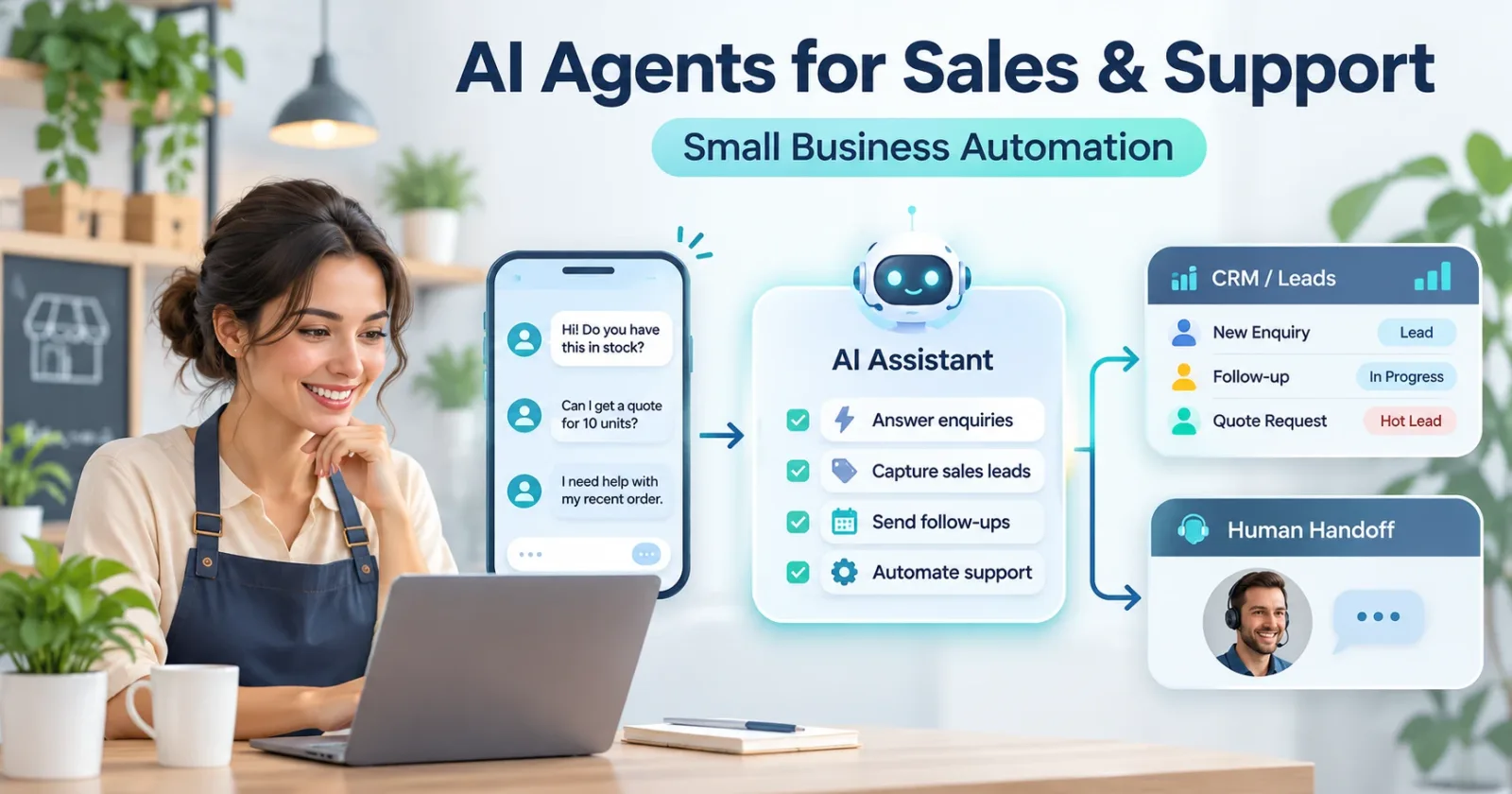
Quick answer: An AI sales agent replies to new enquiries instantly, asks the qualifying questions your best salesperson would ask, shares the right brochure or price list, books a call or visit, sends follow-ups on schedule, and logs every detail in your CRM. Your staff then spend their time on leads that are ready to buy.
1. Instant first reply on every channel
The agent answers WhatsApp, website chat, Instagram DMs and enquiry forms within seconds, including nights and holidays. For leads from click-to-WhatsApp ads, a fast reply also matters for cost, because replying within the customer service window opens Meta's free entry point window (covered in the costs section below).
2. Lead qualification
The agent asks a short set of questions you define, for example budget, location, timeline and what the customer needs. It scores the lead and tags it as hot, warm or cold. A training institute might ask about the course, preferred batch timing and whether the learner can attend classes in Kochi. Keep the criteria relevant and transparent, and do not let the agent guess at a customer's finances or intentions from how they write.
3. Product and price answers from approved data
Connected to your price list, catalogue or Google Sheet, the agent answers "How much is the 2BHK?" or "Is the blue kurta available in XL?" with current information. It should never make up a price or a discount. If the data is missing, it says so and offers to connect the customer with staff.
4. Booking calls, visits and appointments
The agent checks your calendar, offers open slots and confirms the booking. It then sends a reminder before the appointment, which reduces no-shows.
5. Follow-up that does not depend on memory
In many small businesses, the sale is lost in follow-up rather than in the first conversation. The agent can send an approved WhatsApp template to a lead who went quiet after three days, share an offer, and stop as soon as the customer replies or opts out.
6. Automatic CRM updates and owner summaries
Every conversation becomes a CRM record with the customer's name, need, budget and next step. The owner gets a daily summary built from the recorded CRM data, never estimated by the AI, such as "18 new leads, 5 hot, 3 visits booked for tomorrow, 2 complaints waiting for you."
7. Abandoned enquiry and cart recovery
For online stores, the agent can follow up on abandoned carts and answer the question that stopped the purchase, such as delivery time or return policy. Under WhatsApp's rules, these are marketing messages and need the customer's opt-in.
How AI agents help with customer support
Quick answer: An AI support agent answers repeat questions (timings, fees, delivery, returns), checks order or booking status, collects complaint details with photos, creates a ticket, and routes it to the right person with a full summary. Customers get an answer or an acknowledgement in seconds, and staff stop typing the same reply fifty times a day.
Repeat questions, answered from your own knowledge base
In most small businesses, a short list of repeat questions makes up a large share of support messages. The agent answers them from a knowledge base you approve: your FAQ, policies, price list and service details. This method is called retrieval-augmented generation (RAG), and it means the agent looks up your documents before it replies, instead of relying on what the model learned in general. RAG reduces wrong answers but does not eliminate them, so the knowledge base must be kept current: an old price list in the knowledge base produces old prices in chat.
Order, booking and payment status
Connected to your order system, booking tool or a shared sheet, the agent answers "Where is my order?" or "Is my appointment confirmed?" without staff involvement. For an electronics service centre in Ernakulam, "Is my laptop ready?" becomes a status lookup, after the agent confirms the customer's phone number or job card number matches the record. If the system has no confirmed completion date, the agent says so instead of guessing.
Complaint intake and triage
When a customer complains, the agent acknowledges the problem, collects the order number, photos and a description, tags the urgency, and hands it to staff with a one-paragraph summary. It does not promise a refund or compensation on its own. The staff member who picks it up does not need to ask the customer to repeat anything.
Malayalam, English and Manglish
Kerala customers often type messages like "ഈ product stock undo? Tomorrow delivery kittumo?" Current LLMs handle Malayalam script, English and this kind of mixed Malayalam-English typing. Test this with real messages from your own customers before going live, because accuracy varies by model and by how informal the writing is. Voice notes can be transcribed and answered too, which matters for older customers who prefer speaking to typing.
Smart handoff to a person
The most important support feature is knowing when to stop. Good agents escalate when:
- the customer asks for a human, or sounds angry or distressed
- the request involves a refund, a discount, a legal or medical question, or a payment problem
- the agent cannot find the answer in approved information
- the same customer has messaged three times without a resolution
Research supports the human-plus-AI model. A study of more than 5,000 customer support agents found that access to an AI assistant raised issues resolved per hour by about 14% on average, and by 34% for newer, less experienced staff (NBER, Brynjolfsson, Li and Raymond). For a small business that hires freshers, that second number is the interesting one: the AI helps new staff perform closer to your experienced people. Note that this study measured an AI assistant supporting human agents, not an AI replacing them, and results will differ by business.
Which tasks should you hand to an AI agent first?
Quick answer: Hand over tasks that repeat every day and where a wrong answer costs little, such as timings, fees, order status, lead qualification and reminders. Keep a person in charge of tasks where a wrong answer is expensive, such as refunds, negotiations, and medical or legal questions. I use a simple planning tool for this, the Agent Readiness Matrix.
To use the matrix, list every type of message your business received last month, then place each one by two questions: how often does it come in, and what happens if the reply is wrong? Start with Automate first. Move tasks from Agent drafts, person approves to full automation only after the agent's drafts have been approved without changes for several weeks.
Two tasks often look safe but are not. A delivery date sounds routine, but a wrong promise creates a complaint and, as the Air Canada case below shows, possible liability. A discount question sounds harmless, but an agent that offers 10% off to one customer will be quoted by the next. Both stay in Agent drafts, person approves until your data and rules are solid.
AI agent examples for small businesses in Kerala and the Gulf
Quick answer: The best first use case is the one where enquiries repeat, speed affects sales, and the answers already exist in a document or sheet. The table below shows a realistic first agent for eight common small business types, and what it should always hand to a person.
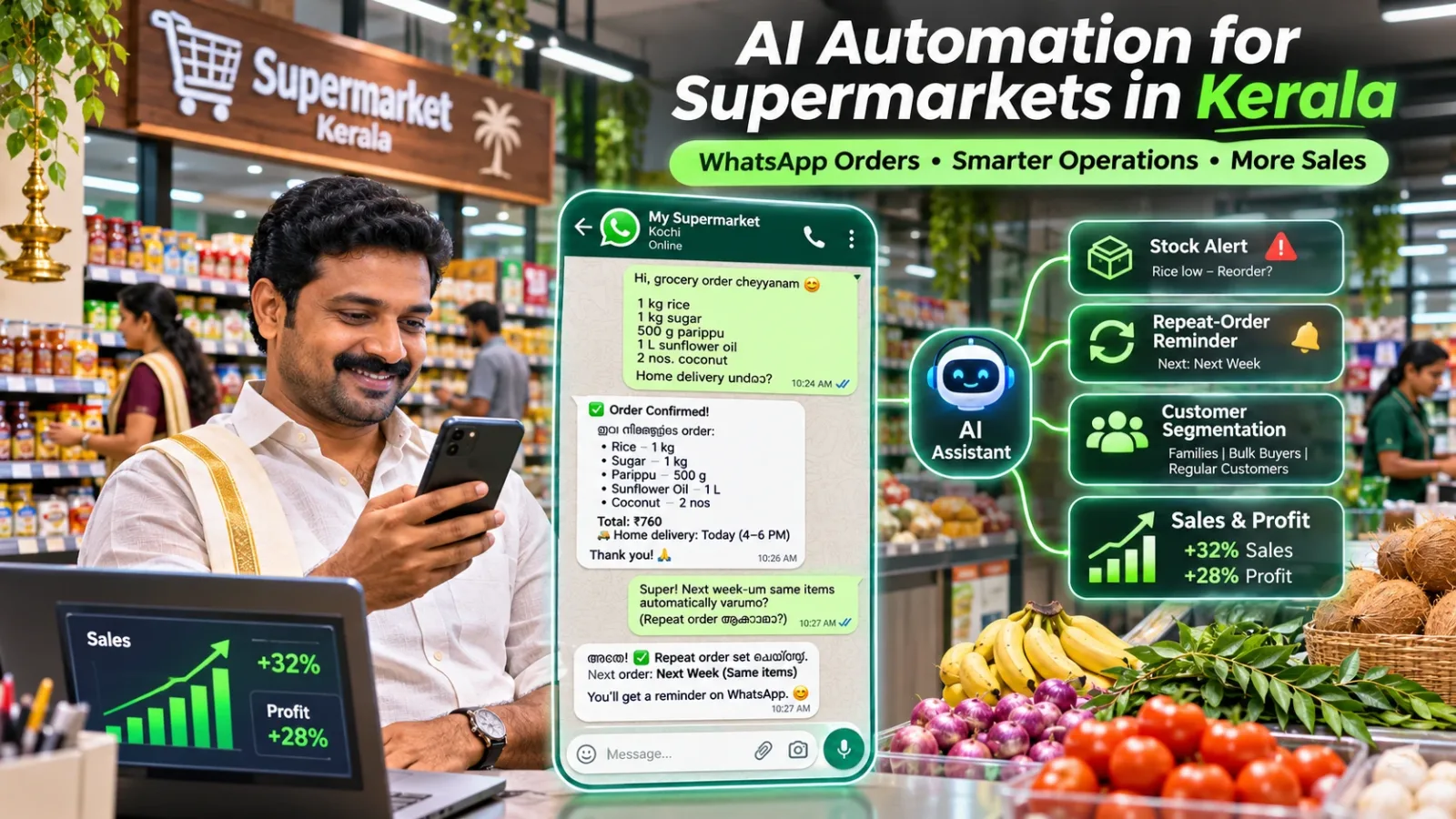
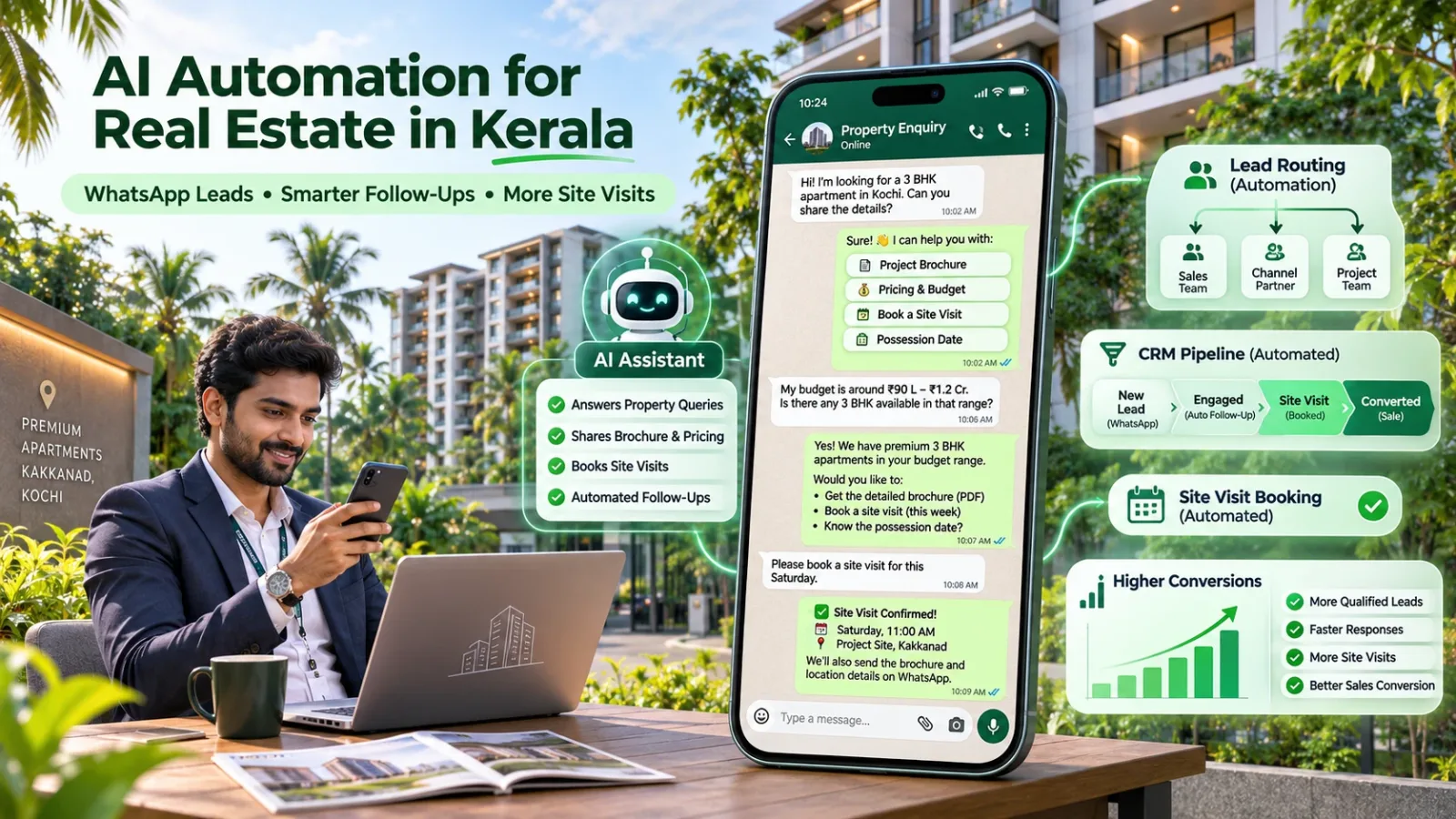
For deeper, sector-specific guides, see our articles on AI and WhatsApp automation for supermarkets in Kerala and for real estate in Kerala.
Worked example: an AI sales agent for a furniture showroom in Kochi
Quick answer: The value of an AI agent comes from the whole system, not the chat replies. In this hypothetical example, the agent connects WhatsApp conversations to the showroom's catalogue, stock records, CRM and sales team, so every enquiry becomes a tracked lead with a next step. It is an illustration, not a client case study.
The situation. The showroom gets enquiries from Facebook and Instagram ads, Google and WhatsApp. Salespeople answer each one by hand, share catalogue photos, check prices and try to remember follow-ups. The owner wants fewer missed enquiries and a clear view of what happens to each lead.
The workflow. This is how I would build it in n8n, with its AI Agent node doing the language work and each outside system connected as a tool:
- Trigger: the enquiry arrives. A customer asks about a sofa set on WhatsApp, often from a click-to-WhatsApp ad, and a webhook starts the workflow.
- Requirement capture: the agent identifies the product type, budget, delivery location and preferences such as colour or fabric.
- Product information: it pulls matching items, photos and prices from the approved catalogue.
- Stock check: if the inventory sheet or system is connected, it checks recorded availability. If not, it says a salesperson will confirm.
- Lead record: it creates a CRM entry with the details, ad source and the customer's consent for follow-up.
- Handoff: requests for customisation, bulk orders or a special discount go to a salesperson with the conversation summary.
- Follow-up: the CRM sets the next action, and an approved template goes out if the customer goes quiet.
- Reporting: the owner sees enquiry volume, popular products, pending follow-ups and conversions each day.
A plain chatbot could do step 3. Steps 4 to 8 are what make it an agent, and they are also where most of the setup work goes.
The failure path. If the catalogue or CRM does not respond, or the agent cannot find an answer in approved data, the customer is told a salesperson will reply, and that salesperson gets an alert with the full chat. A failed run must never mean a silent customer.
The owner. One named person at the showroom updates prices and stock, reads a sample of conversations each week and receives the failure alerts.
What does an AI agent cost a small business?
Quick answer: The cost has three parts: the AI and automation software, the setup work, and the WhatsApp messages themselves. Since 1 October 2026, WhatsApp charges for agent replies after the first 1,000 free service messages per business number each month, so message volume now matters. Measure the result as extra sales or hours saved, not as the number of chats handled.
Three ways to start, from simplest to most capable
How WhatsApp charges for agent replies
Meta charges per delivered message, based on the message category and the customer's country code. Messages from customers to you are free (Meta pricing documentation). The key points for an AI agent:
- Service messages (free-form replies within 24 hours of the customer's last message) are free for the first 1,000 per business phone number each month, since 1 October 2026. From the 1,001st, they are charged. The allowance resets monthly and does not roll over.
- Utility templates sent inside the customer service window, such as booking confirmations, are charged since 1 October 2026.
- Click-to-WhatsApp ads give you a free entry point window. If you reply within the customer service window, Meta does not charge for marketing, utility or service messages to that customer for up to 7 days. This makes an instant agent reply directly valuable for ad leads.
- Meta Business Agent messages, from Meta's own AI agent, are priced separately at USD 2 per million tokens, which Meta estimates at about 4 to 5 US cents per message (Meta).
- Gulf customers are charged at their country's rates.
India rates (Meta's INR rate card, before 18% GST): Rs. 0.8631 per marketing message, and Rs. 0.115 per utility, authentication or service message (summary by Monty Mobile). Your WhatsApp solution provider usually adds a monthly plan or a per-message markup on top. The AI model, hosting and automation tools are separate costs again, so budget for the total, not just the message charges. Rates change, so check the current rate card before you budget.
An illustrative example: a training institute in Kochi
The numbers below are assumptions to show the method. They are not a case study or a promise.
The extra Rs. 1,20,000 is revenue, not profit, and it is an assumption. Nothing here proves an agent will lift conversion by one percentage point. A fuller ROI calculation counts margin and time saved against the full cost:
ROI (%) = (extra gross profit + value of staff time saved - total AI cost) / total AI cost x 100
Total AI cost includes the monthly running cost above plus a fair monthly share of the one-time setup cost, GST and the staff time spent reviewing the agent.
Measure real results before and after launch, ideally by running the agent on one channel or ad campaign and comparing it with another. Track:
- average first reply time, including nights and weekends
- qualified lead rate and appointment booking rate
- conversion to sale or admission
- follow-up completion rate
- handoff rate to staff, and how often the agent's answer was wrong
- cost per resolved enquiry and customer satisfaction
The goal is not more automated conversations. It is more useful business outcomes. If the agent does not lift these numbers, it only adds cost, which is why the 30-day plan below starts by recording your current figures.
Risks, limits and guardrails
Quick answer: The three real risks are wrong answers, customers who feel trapped by a bot, and careless handling of personal data. You manage them by grounding the agent in approved information, giving it clear limits on what it may promise, making it easy to reach a person, and following India's DPDP Act. The business, not the software vendor, is responsible for what the agent tells customers.
Lesson 1: Your business owns what the agent says
In February 2024, a Canadian tribunal ordered Air Canada to compensate a passenger after its website chatbot gave wrong information about a bereavement fare refund. The airline argued the chatbot was responsible for its own words, and the tribunal rejected that, holding the airline responsible for all information on its website (American Bar Association summary of Moffatt v. Air Canada). For a small business, the practical rule is: the agent must never invent a price, discount, refund policy or delivery promise.
Lesson 2: Full automation can backfire
Klarna said in 2024 that its AI assistant handled two-thirds of customer service chats in its first month. By May 2025, its CEO said the cost-focused push had lowered quality, and the company began hiring human support staff again, while keeping AI for simpler queries (Customer Experience Dive). The lesson is not that AI support fails. It is that customers still want a person for complex or emotional issues.
Guardrails every small business agent needs
- Grounding: answer only from approved documents and live data, and say "let me check with the team" when information is missing
- Promise limits: no refunds, discounts, medical advice, legal advice or delivery guarantees without staff approval
- Visible handoff: customers can type "talk to a person" at any point, and the handoff includes the full conversation summary
- Disclosure: tell customers they are chatting with an AI assistant
- Review: a staff member reads a sample of conversations every week and fixes wrong answers in the knowledge base
- Fresh data: someone owns the knowledge base and updates prices, stock, offers and policies the day they change
- Access control: the agent can read only the data it needs, cannot delete records or issue payments, and every action it takes is logged
The DPDP Act and your AI agent
An AI agent collects names, phone numbers and sometimes addresses, health details or payment information, so India's Digital Personal Data Protection Act, 2023 applies. The DPDP Rules were notified on 13 November 2025 and phase in over 18 months. Most substantive duties, including notice and consent, security safeguards, breach notification and data principal rights, apply from around 13 May 2027 (AZB & Partners; Hogan Lovells).
For an AI agent, that means:
- Tell customers what data the agent collects, why, and how long you keep it.
- Collect only what the task needs. A course enquiry does not need a date of birth.
- Get clear consent where the law requires it, especially before marketing messages, and honour opt-outs immediately.
- Restrict who and what can access customer records, including the agent itself.
- Read the data-processing terms of your AI, CRM and messaging providers, and avoid tools that may use customer data for training.
- Set up a way to handle correction, deletion and grievance requests.
- Use proper security controls and a retention policy, so old conversations are not kept forever.
An AI agent does not make a business DPDP compliant by itself. Your exact obligations depend on your role, the data you process and how you process it. The official Act and Rules are available from the Ministry of Electronics and Information Technology. This is general information, not legal advice, and a lawyer or DPDP consultant should review your specific setup.
A 30-day plan to launch your first AI agent
Quick answer: Start with one channel and one job, usually answering and qualifying new WhatsApp enquiries. Measure your current numbers in week 1, build and test in weeks 2 and 3, and go live with a person watching in week 4. Expand only after the first agent proves it helps. Agents with several data sources or custom workflows can take longer than 30 days.
- Week 1: Measure and collect
- Record your baseline: enquiries per day, average first reply time, conversion to sale or booking, and how many enquiries arrive after working hours.
- Export 100 to 200 real customer messages and group them by question type.
- Write or update the answers: prices, timings, policies, locations, FAQs. This becomes the agent's knowledge base.
- Decide what the agent must never do, and when it must hand over.
- Week 2: Build
- Choose your option: Business AI in the app, a no-code platform, or a custom agent.
- Connect the WhatsApp Business Platform, your CRM or Google Sheet, and your calendar if you take bookings.
- Get your WhatsApp templates approved for follow-ups, confirmations and reminders.
- Write the agent's instructions: tone, languages, qualifying questions, escalation rules, AI disclosure.
- Week 3: Test with real messages
- Run the 100 to 200 real messages through the agent and check every answer.
- Test Malayalam, English, Manglish and voice notes.
- Try to break it: ask for discounts, give wrong order numbers, act angry, ask medical or legal questions, try to get another customer's details, and ask things outside the agent's scope.
- Fix the knowledge base, not just the prompt, when an answer is wrong.
- Week 4: Go live with supervision
- Launch on one number or one ad campaign first.
- A staff member reviews every conversation for the first week, then a daily sample.
- Compare against your week 1 baseline: reply time, qualified leads, bookings, sales, handoff rate and complaints.
- Decide whether to expand to support, follow-up or another channel.
Build it yourself or hire an implementation partner?
Quick answer: If you only need answers to common questions on one WhatsApp number, a ready-made tool such as Business AI in the WhatsApp Business app or a no-code platform may be enough. If the agent must connect to your CRM, stock, calendar or billing system, follow custom sales rules, and keep customer data secure, a partner who understands both the technology and your sales process will usually save time and mistakes.
Whichever route you choose, ask these questions before you commit:
- Will it work with the software we already use, and which tools can the agent read from and write to?
- Who owns and controls our customer data and conversation history?
- What happens when the agent gives a wrong answer, and how do we correct it?
- Can staff take over a conversation instantly?
- Is every automated action recorded in a log we can see?
- Can we switch AI models or providers later without rebuilding everything?
- How will results and ROI be measured, and against which baseline?
- Who maintains the system, updates the knowledge base and fixes it when an integration breaks?
The real opportunity is beyond chatbots
The value of an AI agent is not that a computer can answer WhatsApp at midnight. It is that every conversation connects to the next business action: an enquiry becomes a tracked lead, a lead gets its follow-up, a complaint becomes a ticket with an owner, and an appointment request becomes a confirmed booking. Start with one well-designed workflow that uses reliable information, protects customer data and keeps people in charge of important decisions, then grow from there. Before you call it finished, check the four parts: a clear trigger, tested steps, a failure path and a named owner.
How Brain Cyber Solutions can help
Quick answer: Brain Cyber Solutions, a Digital Growth, AI & Automation Company headquartered in Edappally, Ernakulam, builds AI agents, WhatsApp automation and CRM integrations for small businesses, and trains business owners and teams to run them through Maattam, its AI Learning & Professional Growth Ecosystem.
If you want it built for you. We map your enquiry and support flow, prepare the knowledge base, connect WhatsApp, your CRM and calendar, set the handoff rules, and test with your real customer messages before launch. Our work covers AI implementation, AI chatbots and agents, workflow automation, CRM integration and WhatsApp automation. Working in search, marketing and business systems since 2005, we have delivered more than 100 international projects.
If you want your team to build and manage it. Our AI Business Automation Course (MCAIS) is a 42-day live online course run under the Maattam brand and taught in Malayalam, for Malayalam speakers in Kerala, the Gulf and beyond. It covers workflow automation with n8n, Make and Zapier, the WhatsApp Cloud API, AI agents and CRM integration, using tools such as Claude, ChatGPT and Gemini, so learners move beyond prompting to building working business automations. I am one of the mentors. A plus two (12th) pass is enough and no coding is needed. The fee is Rs. 25,000 + GST for the current batch (regular fee Rs. 37,000 + GST), with EMI, UPI, bank transfer, credit card and debit card accepted. The MCAIS certificate follows practical projects, a capstone and an assessment. For teams, see corporate training.
Message us on WhatsApp with one line about your business and your biggest enquiry problem, call +91 73068 95402, or see our contact page.
Frequently asked questions
Can a small business afford an AI agent?
Yes. The simplest option, Business AI in the WhatsApp Business app, has no setup cost for eligible Indian small businesses. A custom agent costs more to set up, but running costs can be a few thousand rupees a month for software plus WhatsApp message charges. Compare that with the value of one extra sale or booking per week.
Will an AI agent replace my sales or support staff?
No. It removes repetitive work such as first replies, FAQs, status checks and follow-up reminders, so your staff spend time on qualified leads, complaints and complex questions. Klarna's experience shows that removing people entirely can lower service quality, and research shows AI assistance helps newer staff resolve about a third more issues per hour.
Can an AI agent reply in Malayalam?
Yes. Current large language models understand and write Malayalam script, English and mixed Malayalam-English (Manglish), and many WhatsApp setups can transcribe voice notes. Accuracy varies by model and writing style, so test the agent with 100 or more real messages from your own customers before launch.
What is the difference between an AI agent and a WhatsApp chatbot?
A traditional WhatsApp chatbot follows fixed menus and keywords. An AI agent understands free-text messages, decides the next step, and takes actions in your other tools, such as checking stock, booking an appointment or updating your CRM. The agent is more flexible but must be grounded in approved information.
Does WhatsApp charge for AI agent replies?
Since 1 October 2026, yes, after a free allowance. Each business phone number gets 1,000 free service messages a month, and replies after that are charged per delivered message. Messages to customers who came from a click-to-WhatsApp ad are free for up to 7 days if you reply within the customer service window.
What happens if the AI agent gives a wrong answer?
Your business is responsible, as the 2024 Air Canada tribunal decision showed. Reduce the risk by limiting the agent to approved information, blocking promises on price, refunds or delivery, reviewing conversations weekly, and making it easy for customers to reach a person.
Is an AI agent legal under India's DPDP Act?
Yes, if you handle personal data properly. Tell customers what you collect and why, collect only what you need, get consent for marketing, protect the data, and honour correction and deletion requests. Most DPDP Rules obligations apply from around 13 May 2027, so build these practices in from the start.
How long does it take to set up an AI agent?
A focused first agent for one channel and one job, such as answering and qualifying WhatsApp enquiries, can go live in about 30 days. That includes a week to collect real customer questions, a week to build, a week to test, and a supervised first week live.
Can an AI agent increase sales?
It can, but it is not guaranteed. An agent improves first reply time, lead qualification and follow-up consistency, which often lift conversions, especially for enquiries that arrive after hours. Measure your reply time, booking rate and conversion rate before launch and compare them after a month to see whether it actually helped.
Can AI agents update my CRM automatically?
Yes, when the agent is connected to your CRM with the right permissions. It can create leads, record the customer's requirements, update the lead status and trigger follow-up tasks. Without that connection, the agent can only chat, and staff still have to copy details by hand.
What is the best first AI agent for a small business?
For most enquiry-driven businesses, the best first agent answers and qualifies new WhatsApp enquiries and books calls or visits. These tasks repeat every day, speed directly affects sales, and a wrong answer is usually easy to correct. Leave refunds, negotiations and complaints with staff at first.
Can an AI agent handle customers in the UAE and other Gulf countries?
Yes. An agent can reply in Malayalam, English or Arabic at any hour, which suits businesses with Gulf-based customers. WhatsApp charges messages to Gulf numbers at those countries' rates, and you should check local messaging and data protection rules for each market you serve.
Are AI agents safe for customer data?
They can be, but safety is not automatic. Give the agent access only to the data it needs, use secure integrations and vendors with clear data-processing terms, log every action, keep personal data only as long as needed, and keep a person reviewing conversations.
Editorial note: the showroom, institute and service centre scenarios and the financial example are illustrative, not client case studies or guaranteed results.
Sources